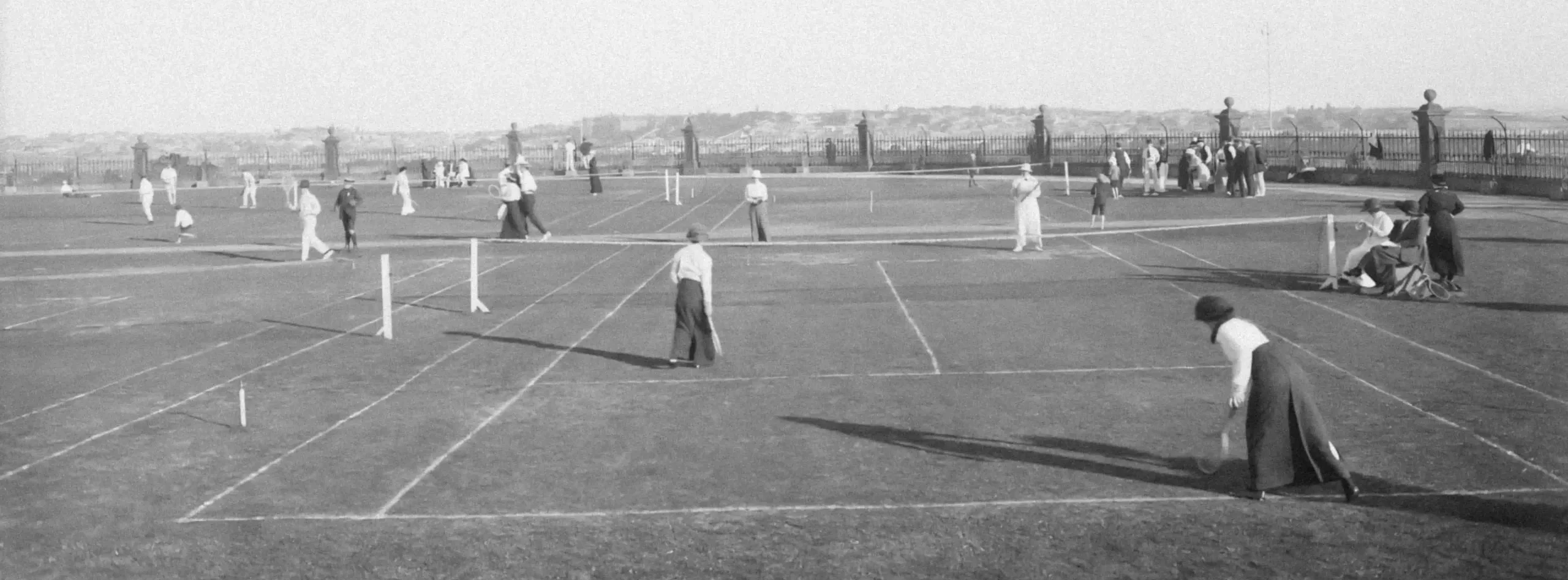


The history of women’s tennis is a remarkable journey of determination, skill, and breaking barriers that spans over 150 years. From its humble beginnings in Victorian England to the modern era of million-pound prize funds and global superstars, women’s tennis has evolved into one of sport’s most compelling narratives.
The Victorian Era: Early Beginnings (1870s-1900)
Women’s tennis emerged in the 1870s alongside the sport itself, though initially under strict social constraints. The first women’s tennis tournament took place at the Staten Island Cricket Club in New York in 1876, not long after tennis was invented. However, female players were required to wear full-length dresses, corsets, and hats whilst playing—hardly ideal sporting attire.
The All England Croquet and Lawn Tennis Club introduced the Ladies’ Singles Championship at Wimbledon in 1884, seven years after the men’s tournament began. Maud Watson became the first Wimbledon ladies’ champion, defeating her sister Lilian in the final. The prize was a silver flower basket worth 20 guineas—a far cry from today’s substantial prize money.
Breaking Social Barriers (1900-1920)
The early 20th century saw gradual changes in both playing conditions and social acceptance. French player Suzanne Lenglen revolutionised women’s tennis in the 1920s, not just through her exceptional play but by wearing shorter skirts and abandoning the restrictive corsets that had previously been mandatory.
Lenglen dominated women’s tennis from 1919 to 1926, winning six Wimbledon singles titles and introducing a more athletic, aggressive style of play. Her influence extended beyond the court, as she helped establish tennis as a viable career for women and demonstrated that female athletes could be both competitive and commercially successful.
The Amateur Era Champions (1920-1968)
Between the wars and into the post-war period, women’s tennis produced legendary champions who played for glory rather than prize money. Helen Wills Moody dominated the late 1920s and 1930s, winning 19 Grand Slam singles titles with her powerful baseline game and steely determination.
The 1950s and 1960s saw the emergence of Maureen Connolly, who became the first woman to complete the Grand Slam in 1953 at just 18 years old. Her career was tragically cut short by a horse-riding accident, but her impact on the sport remained profound.
During this period, the equipment used by female players was quite different from today’s standards. Wooden racquets dominated, typically weighing between 12-14 ounces and requiring natural gut strings for optimal performance. Players like Billie Jean King began experimenting with slightly heavier racquets to generate more power, foreshadowing the equipment evolution that would transform the sport.
The Open Era Revolution (1968-1980)
The introduction of prize money in 1968 marked the beginning of the Open Era, but women initially received significantly less than their male counterparts. This disparity led to the formation of the Virginia Slims Circuit in 1970, pioneered by Billie Jean King and eight other players who risked their careers to fight for equality.
King’s victory over Bobby Riggs in the 1973 “Battle of the Sexes” match, watched by 90 million viewers worldwide, became a defining moment for women’s sport. Playing with a Wilson T2000 steel racquet—the same model used by Jimmy Connors—King demonstrated that women’s tennis could draw massive audiences and deserved equal respect.
The late 1970s saw Chris Evert and Martina Navratilova begin their legendary rivalry. Evert’s precision baseline game, often executed with a Wilson Pro Staff racquet strung with natural gut, contrasted beautifully with Navratilova’s aggressive serve-and-volley style using her favoured Yonex racquet.
The Power Game Emerges (1980-2000)
The 1980s and 1990s witnessed a dramatic increase in power and athleticism in women’s tennis. Steffi Graf’s devastating forehand and Monica Seles’ two-handed groundstrokes from both wings revolutionised shot-making. The introduction of graphite racquets allowed players to generate unprecedented power whilst maintaining control.
Graf’s choice of a Wilson Pro Staff Classic racquet, similar to those used by male players, reflected the evolving equipment needs of the women’s game. The racquet industry began developing models specifically designed for the women’s tour, balancing power with manoeuvrability.
This era also saw the rise of the Williams sisters, Venus and Serena, who brought unprecedented power and athleticism to women’s tennis. Their success with heavier, more powerful racquets—Venus using Wilson Hammer racquets and Serena favouring Wilson Pro Staff models—influenced equipment choices throughout women’s tennis.
The Modern Era (2000-Present)
Today’s women’s tennis represents the culmination of decades of evolution in technique, fitness, and equipment. Modern players use racquets weighing 9-11 ounces with polyester strings that allow for extreme topspin whilst maintaining control. The Head Speed series, favoured by players like Novak Djokovic, has also found success with female players who prefer its manoeuvrability.
Prize money equality has been achieved at all four Grand Slams, with Wimbledon being the last to introduce equal prize money in 2007. The women’s game now attracts global audiences and produces superstars who transcend sport.
Contemporary champions like Serena Williams, who dominated the sport for over two decades, have inspired a new generation of players. Williams’ equipment evolution—from her early Wilson nSix-One 95 to her later Wilson Pro Staff models—reflected the sport’s technological advancement.
Equipment Evolution in Women’s Tennis
The history of women’s tennis equipment tells its own fascinating story. Early players used heavy wooden racquets with small heads and natural gut strings. The 1970s saw the introduction of steel racquets like the Wilson T2000, which offered better control but required significant strength to wield effectively.
The graphite revolution of the 1980s transformed the women’s game. Racquets became lighter yet more powerful, allowing female players to compete with increased pace and spin. Modern women’s tennis racquets typically feature:
- Head sizes between 95-105 square inches for optimal power and control
- Weights ranging from 9-11 ounces when strung
- String patterns often more open (16×19) to enhance spin generation
- Advanced materials including carbon fibre and tungsten for optimal balance
Today’s top female players often use racquets similar to their male counterparts, reflecting the athleticism and power of the modern women’s game. The choice between polyester strings for durability and spin versus natural gut for feel and power remains a key equipment decision for serious female players.
Looking Forward
The history of women’s tennis demonstrates sport’s power to drive social change whilst producing extraordinary athletic achievement. From Maud Watson’s restrictive Victorian dress to today’s high-performance athletic wear, from wooden racquets to space-age carbon fibre, women’s tennis has continually evolved whilst maintaining its essential character.
Modern women’s tennis continues to push boundaries, with players achieving speeds and spin rates that would have been unimaginable to earlier generations. The sport’s global reach and commercial success vindicate the struggles of pioneers like Billie Jean King who fought for recognition and equality.
As we look to the future, women’s tennis stands as a testament to the power of determination, skill, and the relentless pursuit of excellence—qualities that remain unchanged despite all the technological and social evolution of the past 150 years.