

From monastery walls in medieval France to the pristine grass courts of Wimbledon, tennis has evolved from a humble hand-ball game into one of the world’s most beloved sports. But who actually invented tennis as we know it today? The answer reveals a fascinating journey through centuries of innovation, royal patronage, and sporting revolution.
The Medieval Origins: Jeu de Paume
The story of tennis begins not with racquets and nets, but with monks and monastery walls. Tennis traces its origins to a 12th-13th century French handball game called jeu de paume (“game of the palm”), where players struck a ball against walls using their hands.
The game was particularly popular among ecclesiastical figures – prelates, abbots, and minor clergy played it with almost religious fervour. In some French provincial towns, bishops even received a tithe of tennis balls on Easter Day, highlighting the game’s cultural significance.
The term “tennis” itself likely stems from the Anglo-Norman cry “tenetz!” – meaning “take this!” or “play!” – shouted by the server before each point. This linguistic heritage connects today’s game directly to its medieval roots.
Equipment Evolution
As jeu de paume gained popularity, players began protecting their hands with leather gloves. These gloves evolved to acquire gut strings in the style of a guitar, eventually developing into short-handled paddles covered with vellum. This early equipment evolution would eventually lead to the modern tennis racquet.
Harry Gem & the Birth of Lawn Tennis
Before Walter Clopton Wingfield received official recognition, the actual origins of lawn tennis were quietly taking shape in Birmingham, UK. The true pioneers were Major Thomas Henry “Harry” Gem and his friend Augurio Perera, who began experimenting with their new game as early as 1859.
The Edgbaston Experiments
Their first experiments took place in the garden of Perera’s home in Ampton Road, Edgbaston, Birmingham, where they initially called their game “Lawn Rackets” or “Pelota” in homage to Perera’s Spanish roots. A commemorative plaque now marks this historic house where the earliest recognisable form of lawn tennis was first played.
Harry Gem was far from a casual sportsman. He was Clerk to the Birmingham magistrates, an accomplished amateur actor, swimmer, horseman, archer, and racquets player who had founded the Bath Street Racquets Club and the Union Club in Birmingham. It was at the Racquet Court Inn in Bath Street, opposite St Chad’s Cathedral, where Gem and Perera first conceived of creating a less expensive outdoor alternative to indoor racquets.
The World’s Oldest Tennis Cub
Central to this story is Edgbaston Archery and Lawn Tennis Society, founded in 1860 and recognised as the oldest lawn tennis club in the world (and still going today!). The club’s remarkable claim to this title is supported by meticulous record-keeping – the club has maintained all its minutes since 1860, which are stored in the archives at Birmingham Library.
The Society moved to its current premises next to Birmingham Botanical Gardens in 1867, and tennis was established there in the early 1870s – with evidence suggesting competitions were being played by 1875. Remarkably, the Society’s six grass courts occupy the same piece of ground where the originals were laid down in the early 1870s, making this the oldest lawn tennis playing surface still in regular use anywhere in the world.
The club’s historical significance was formally recognised when Birmingham Civic Society awarded them a Blue Plaque in 2020 to commemorate the club’s place in lawn tennis history. The timing of the club’s tennis adoption is particularly significant – on 21st March 1877, the Annual Meeting decided to alter the name to “The Edgbaston Archery and Lawn Tennis Society”, which was three weeks prior to the All-England Croquet Club in Wimbledon adding “lawn tennis” to its title.
From Birmingham to Leamington
After perfecting their game in Birmingham, Gem and Perera moved to Leamington Spa where, in 1874, they formed what might have been the world’s first tennis club specifically created for lawn tennis at the Manor House Hotel, in conjunction with local doctors Arthur Tompkins and Frederic Haynes. Though this Leamington club didn’t survive long, it demonstrated the rapid spread of the game from its Birmingham birthplace.
Walter Clopton Wingfield
While the Birmingham pioneers were quietly developing the foundations of modern tennis, it was Major Walter Clopton Wingfield who brought lawn tennis to wider public attention and official recognition in 1873.
Wingfield’s innovation was revolutionary in its commercialisation and standardisation. He published the first book of rules in 1873 and took out a patent on his game in 1874, calling it “Sphairistiké” (Greek for “playing ball”). His key innovations included:
- The rubber ball: Providing consistent bounce on grass surfaces
- The hourglass-shaped court: Distinguishing his game from traditional rectangular courts
- Standardised rules: Creating the foundation for competitive play
- Commercial packaging: Making the game accessible to a wider public
Wingfield’s version caught on rapidly across Britain and soon spread to the United States, where it would undergo further refinement.
Establishing the Modern Game
The transformation from the Birmingham experiments and Wingfield’s commercial innovation to the tennis we recognise today happened remarkably quickly. In 1877, the All England Croquet Club decided to hold a tennis championship at Wimbledon, appointing a championship subcommittee that made crucial decisions about court dimensions and scoring.
This committee took the revolutionary step of abandoning Wingfield’s hourglass-shaped court in favour of the rectangular format we know today. These decisions proved prophetic:
- Court dimensions: 78 feet (23.8 metres) long by 27 feet (8.2 metres) wide
- Scoring system: Adapted from real tennis – 15, 30, 40, game
- Service rules: Allowing one fault (two chances per point)
Twenty-two players entered that first championship, with Spencer Gore becoming the inaugural Wimbledon champion. The tournament’s success established Wimbledon as tennis’s spiritual home and validated the new rectangular court format over both Wingfield’s hourglass design and the various experimental formats being used elsewhere.
Tennis Equipment Through the Ages
The evolution of tennis equipment tells its own story of innovation and technological advancement. While the basic concept of a strung racquet hitting a ball over a net has remained constant, the refinements have been revolutionary.
From Wood to Wonder Materials
Tennis racquets, which historically had been of a standard size and shape and constructed primarily of laminated wood, were suddenly manufactured in a wide choice of sizes, shapes, and materials, with the most significant milestones being the introduction of metal frames beginning in 1967 and the oversized head in 1976.
Today’s players choose from frames made with graphite, carbon fibre, and advanced composites. Whether you’re selecting your first racquet or upgrading your equipment, understanding this evolution helps inform modern choices. Our comprehensive guides to the best tennis racquets for beginners, intermediate players, and advanced players explore how these innovations translate into performance benefits for players at every level.
String Technology Revolution
String technology has paralleled racquet development in sophistication. Early players used natural gut strings, but modern synthetic materials offer enhanced durability, spin potential, and feel. The relationship between racquet and strings is crucial – understanding how different combinations affect your game is covered in our complete guide to tennis strings.
Court Surface Innovation
Tennis balls have undergone similar transformation. Tennis balls, which historically had been white, now came in several hues, with yellow becoming the colour of choice. This change wasn’t merely aesthetic – yellow balls offered improved visibility for television broadcasts and players alike.
The Global Spread of Tennis
Tennis’s expansion from English lawns to worldwide phenomenon happened with remarkable speed.
Early International Development
Tennis had taken firm root in Australia by 1880, with the first Australian Championships played in 1905. The United States embraced the sport equally enthusiastically, with the first U.S. championship held in 1880 at the Staten Island Cricket and Baseball Club, won by an Englishman, O.E. Woodhouse.
The first French Championships were held at the Stade Français in 1891, though it didn’t become truly international until 1925. Other nations followed: Canada (1890), South Africa (1891), Spain (1910), and Denmark (1921).
Women’s Tennis Emergence
Women’s tennis gained recognition relatively early, with a women’s championship introduced at Wimbledon in 1884, followed by women’s national championships in the United States starting in 1887.
Tennis in the Modern Era
The sport underwent another revolution in the late 1960s when professional players were allowed to compete alongside amateurs in major championships. This “Open Era” transformed tennis from a gentleman’s pastime into a global entertainment phenomenon.
Technology and Performance
Modern tennis places increasing demands on players’ equipment. Top competition is a demanding test of both shot making and stamina, rich in stylistic and strategic variety. Today’s players need equipment that can handle the power and spin of modern tennis while providing the comfort necessary for long training sessions.
The importance of proper footwear has grown alongside the sport’s physical demands. Court surfaces vary dramatically – from Wimbledon’s grass to Roland Garros’s clay to the hard courts of the US Open. Choosing appropriate footwear for different surfaces is crucial for performance and injury prevention, which is why we’ve created our comprehensive guide to the best tennis shoes.
Real Tennis: The Sport That Never Died
While lawn tennis captured the world’s attention, its predecessor survived. Real tennis (called court tennis in the United States and royal tennis in Australia) continues to be played to a limited degree.
Between 1550 and 1700, there were no fewer than 250 courts of various shapes and sizes in Paris alone. Though most disappeared over time, dedicated enthusiasts have preserved this ancient game, with courts still operating at exclusive venues worldwide.
The Professional Game Today
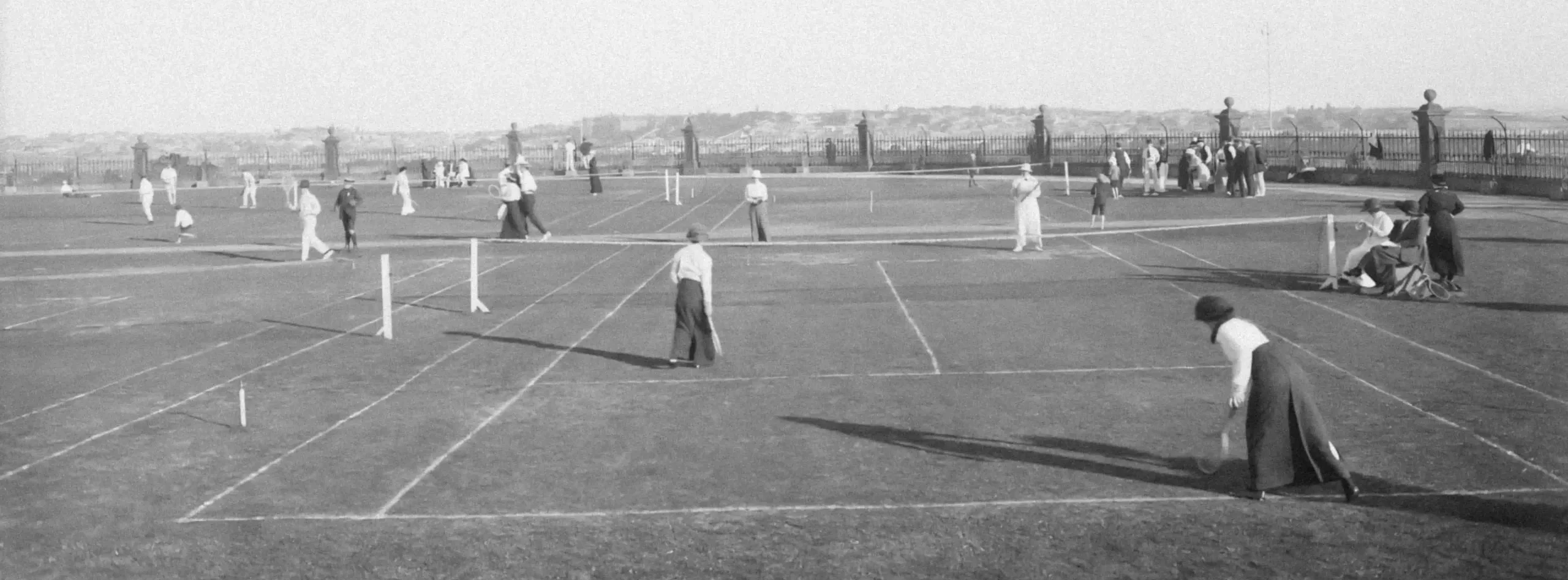
Tennis has evolved far beyond its aristocratic origins. From its beginnings as a garden-party game for ladies in whalebone corsets and starched petticoats and men in long white flannels, it has evolved into a physical chess match in which players attack and defend, exploiting angles and technical weaknesses.
Tournaments now offer tens of millions of dollars in prize money annually, and the sport’s global reach continues expanding through television coverage and grassroots development programmes.
Tennis Equipment for Modern Players
Understanding tennis’s rich history helps appreciate how today’s equipment has evolved to meet player needs. Whether you’re inspired by the medieval monks who first played with their hands or the modern professionals who’ve elevated the game to an art form, choosing the right equipment remains crucial.
Modern players benefit from centuries of innovation. Racquet technology that would have seemed magical to Major Wingfield now allows players at every level to express their potential on court. String technology offers precise control over power, spin, and feel that early players could never have imagined.
The relationship between equipment and performance has never been more sophisticated. Today’s recreational players have access to technology that surpasses what professionals used just decades ago. This democratisation of high-performance equipment means that understanding your needs and matching them to appropriate gear becomes increasingly important.
The Future of Tennis
Tennis continues evolving, with new technologies and training methods constantly emerging. From smart racquets that analyse your swing to court surfaces designed for optimal performance and sustainability, innovation remains constant.
The sport’s fundamental appeal endures: the tactical battle between opponents, the physical and mental demands, and the pure satisfaction of a perfectly struck ball. These elements connect today’s players directly to those medieval monks who first enjoyed striking a ball against monastery walls.
Conclusion
The question “who invented tennis?” reveals a sport with deep historical roots and continuous evolution. From the anonymous French monks who played jeu de paume to the Birmingham pioneers Harry Gem and Augurio Perera who first played recognisable lawn tennis in Edgbaston, from Major Walter Clopton Wingfield’s commercial innovation to Spencer Gore’s first Wimbledon victory, tennis represents centuries of human innovation and passion.
Birmingham’s role in tennis history deserves particular recognition. The experiments at “Fairlight” in Ampton Road, Edgbaston, and the establishment of Edgbaston Archery and Lawn Tennis Society as the world’s oldest surviving tennis club, demonstrate that tennis’s true birthplace was in the suburbs of Britain’s second city. The fact that tennis is still played on the same ground in Edgbaston where it was first established in the early 1870s provides a remarkable physical connection to the sport’s origins.
Tennis’s journey from medieval monasteries to modern stadiums, via the gardens of Edgbaston, demonstrates sport’s unique ability to evolve while maintaining its essential character. Whether you’re stepping onto court for the first time or competing at the highest levels, you’re participating in a tradition that spans nearly a millennium and was significantly shaped by the vision of Birmingham pioneers who saw the potential for a new outdoor game.
The equipment may have changed dramatically – from bare hands to high-tech racquets, from monastery walls to perfectly maintained courts – but the fundamental joy of the game remains unchanged. Every time you step onto court, you’re continuing a story that began with medieval monks, was refined by Birmingham innovators, commercialised by Victorian entrepreneurs, and continues with every serve, volley, and winning shot played today.
Understanding this rich heritage adds depth to every match, connecting us to the countless players who’ve contributed to tennis’s magnificent evolution from humble medieval pastime to global sporting phenomenon, with Birmingham’s Edgbaston district holding the proud distinction of being lawn tennis’s true birthplace.